Showing posts with label feedsack. Show all posts

October 24, 2014

A Little More About American Feedsacks...

Feedsack fabric I purchased from Pat's Sacks Tuesday evening.
I received a question from my blog friend, Mandy on my recent feedsack post, asking me to explain how they were used. I'm sorry I wasn't more clear about that in my original post, so I'm going the share more photographs from Tuesday night, along with a further explanation for you.
Feedsacks were used to hold and transport various goods beginning in the early 1800s and ending in the mid-1960s. Originally, food staples, grains, seed and animal feed was packed into boxes and wooden barrels. These containers were bulky, and frequently leaked or were easily damaged. Plus, they were bulky and heavy to transport.

Manufacturers wanted another method for containing their goods, but homespun bags (considered "junk fabric") used by farmers to store goods at home, weren't considered because the hand sewn seams couldn't hold up to heavy use. After the invention of the sewing ("stitching") machine, it was more efficient and a sturdier method for double locking seams on cloth to hold those same goods. This technology then made fabric containers useful to manufacturers.
Feedsacks were originally made of heavy canvas and used to hold and carry flour, sugar, meal, grain, salt and feed from the mills, and they were reusable so the farmers could bring their empty sacks (stamped with their own identifying mark) back to the mill to be filled and refilled.

Farmers got a lot of use out of those sacks until the North East mills began weaving inexpensive cotton fabric in the late 1800s. Originally they were printed on plain, white cloth in sizes that corresponded to barrel sizes, (a one barrel bag held 196 pounds of flour.) and the brand names were simply printed on the side of the bag.
Once a thrifty farm wife figured out that the cotton bag was a ready source for dishcloths, diapers, nighties and other household items, they started bringing them in from the barns into their homes. "A 1942 estimate showed that three million women and children of all income levels were wearing printed feedbag garments."
When manufacturers realized just how their feedsacks were being used, they knew they had better advertising opportunities, making them in various prints and patterns, as well as in solid colors. Their salesmen would often carry their feedsacks into town and hang them over their chairs at the local eateries to promote their products. Directions were even given for using the strings in knitting and crocheting. Later, they used feedsacks as premiums, including them in soap and cereal boxes, for example.

I remember my mother purchasing large boxes of dry laundry detergent when I was a kid just for the "gift with purchase". It was fun to open those boxes and pull out the towel, shaking it to get the soap off.  Of course, if you wanted a matched set, you'd have to buy more soap!
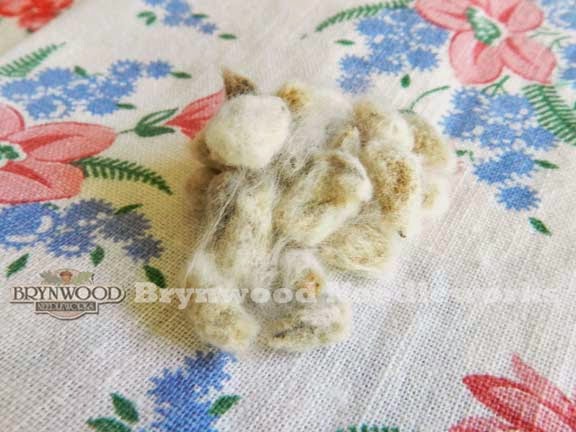
Cecelia also gave me some cotton seeds so I could try growing my own plants!
Feedsacks became more colorful, with printed patterns that could more readily be used for dresses, tablecloths, curtains, pre-printed fabrics that were sewn together to make stuffed toys, and of course, those functional (and now beloved) quilts.

After World War II, heavier paper and plastic were more economical containers. The manufacturers then incorporated polyester into their bags, and the sacks soon fell out of favor with farm wives, who preferred the 100% cotton for their purposes. The cotton feedsacks were only produced until 1965, and the vintage ones have have become cherished collectibles.
A free handout from Cecelia of Pat's Sacks
I am, by no means any expert in this field. Most of what I'm sharing is due to the knowledge Cecelia shared with our guild on Tuesday evening. There are, however, many sources available to learn more about this fascination subject. 

In case you're interested, I know that there are a many examples of feedsack fabric and actual intact feedsacks available on Ebay (Don't bid against me, please). Have fun learning more thanks to the internet.

Thanks for the question, Mandy! I hope this helps clear things up a bit.
DonnaAcornSignature

October 22, 2014

Fascinated With Feedsacks...

 We had a special program at our guild meeting last night. Cecelia Reed
brought her vintage feedsack quilts, garments and bags to share with us.

I took over eighty photographs, but have managed to pare it down to ten to share.
 Cecelia's business is called "Pat's Sacks" after her mom, Pat who was a self-
proclaimed "hoarder" of all things related to feedsacks. Not only was Pat's home
decorated with feedsack creations, she had an entire room designated for all of
the vintage pieces she acquired over the years. Cecelia has taken over that role.
 As Pat began her program, she kept saying that the early quilts were boring and
drab. I kept thinking that I couldn't agree. Each of these quilts was an exercise
in color and frugality. Women of yesteryear saved and used every little piece
of fabric they could find to dress or warm their family members and loved ones,
and the designs were anything but boring. There was so much work in each one!
 This particular quilt is actually covered by another quilt in an 
effort to conceal and preserve the blocks beneath that were deteriorating.
Cecelia shared fully-intact sacks, as well as those which had been sewn into
aprons and other items. Even though she only brought a small selection of her 
favorites, there was still a staggering number of them displayed for our program.
Some of the nubby cotton sacks were cut up and sewn into baby (or adult) 
undergarments. Many of the original bags were burlap. Can you imagine 
wearing a pair of scratchy burlap undies every day? Those were the days!

Cecelia did mention that she sleeps on now-soft, cotton feedsack sheets.
Her quote was that sleeping on those vintage sheets is "absolute Heaven".
I was especially taken with this feedsack nighty with a crocheted bodice and 
sleeves. There was a soft, blue ribbon woven through the crocheting. I would
wear this in a heartbeat! I loved the air of nostalgia and those simple days gone by.
We all gasped when Cecelia opened up this Drunkard's Path quilt. So much work!
Likewise, this quilt was made from tiny scraps of vintage feedsacks. Many of these
 quilts were referred to as "summer quilts", because they were made with sacks on the
front and the back, with no cotton batting in between...lightweight for hot nights.
(These certainly don't read "boring and drab" to me. How about you?)
  Cecelia's mother created many of these quilts. She hand or machine pieced them
and then hand quilted them. She was a nationally recognized and awarded quilter.
Looking at her work, it was apparent that she loved creating every one of them.

Pat saved a 2" square of every feedsack she ever came across. Those squares 
were then stored in slip sheets in multiple looseleaf binders - now in her
daughter's possession. They are a definitive record of printed sacks in the United
States, and will eventually reside in an archive in Utah, where a person can
actually earn degree in feedsack expertise! She plans to hand deliver them when 
she decides that she's able to part with them. For now, she and guild members
are able to enjoy the vast wealth of knowledge Pat left in her daughter's hands.
DonnaAcornSignature 
PS. While my friend, Ellen's surgery took longer than expected yesterday, her surgeon is very happy with the results. We stayed in Ft. Myers until late day for a post-op appointment, and when the bandages came off, Ellen could see where she had previously been unable to see. She nearly cried for joy. I was blessed to be with her as we shared her happy results. I took her back home and then I returned home after 6:00. It was a long, tiring and thoroughly miraculous day. She wanted me to tell you, "Thank you from both of us for your prayers and kind wishes."