Showing posts with label cotton. Show all posts

February 15, 2017

Shades of Purple...

Brynwood Needleworks - Shades of Purple

Stitches came out and now I can fully concentrate (and smile) a little easier. After I got home from the doctor's office, I went to the studio to pull purple fabrics. I have three clients who have requested Crossbody Clutch Wallets which incorporate purple into the linings.

Brynwood Needleworks - Shades of Purple
 
I love the Tula Pink owls I showed you before, but decided to pull other options, so that they wouldn't all be matchy smatchy. I'll be making them with different cork exteriors...black, black with silver flecks, and natural.
 
Brynwood Needleworks - Purple Cork
 
I also have a purple cork on its way, but I'm going to wait until it arrives to try to match a lining fabric with it. Computer monitors, editing software, cameras and eyes all see color differently, so I won't know if this image is color accurate until it arrives in a few days.

In the meantime, I'll be finishing up on my outstanding orders while I think about all the "shades of purple" possibilities.

DonnaAcornSignature

October 24, 2014

A Little More About American Feedsacks...

Feedsack fabric I purchased from Pat's Sacks Tuesday evening.
I received a question from my blog friend, Mandy on my recent feedsack post, asking me to explain how they were used. I'm sorry I wasn't more clear about that in my original post, so I'm going the share more photographs from Tuesday night, along with a further explanation for you.
Feedsacks were used to hold and transport various goods beginning in the early 1800s and ending in the mid-1960s. Originally, food staples, grains, seed and animal feed was packed into boxes and wooden barrels. These containers were bulky, and frequently leaked or were easily damaged. Plus, they were bulky and heavy to transport.

Manufacturers wanted another method for containing their goods, but homespun bags (considered "junk fabric") used by farmers to store goods at home, weren't considered because the hand sewn seams couldn't hold up to heavy use. After the invention of the sewing ("stitching") machine, it was more efficient and a sturdier method for double locking seams on cloth to hold those same goods. This technology then made fabric containers useful to manufacturers.
Feedsacks were originally made of heavy canvas and used to hold and carry flour, sugar, meal, grain, salt and feed from the mills, and they were reusable so the farmers could bring their empty sacks (stamped with their own identifying mark) back to the mill to be filled and refilled.

Farmers got a lot of use out of those sacks until the North East mills began weaving inexpensive cotton fabric in the late 1800s. Originally they were printed on plain, white cloth in sizes that corresponded to barrel sizes, (a one barrel bag held 196 pounds of flour.) and the brand names were simply printed on the side of the bag.
Once a thrifty farm wife figured out that the cotton bag was a ready source for dishcloths, diapers, nighties and other household items, they started bringing them in from the barns into their homes. "A 1942 estimate showed that three million women and children of all income levels were wearing printed feedbag garments."
When manufacturers realized just how their feedsacks were being used, they knew they had better advertising opportunities, making them in various prints and patterns, as well as in solid colors. Their salesmen would often carry their feedsacks into town and hang them over their chairs at the local eateries to promote their products. Directions were even given for using the strings in knitting and crocheting. Later, they used feedsacks as premiums, including them in soap and cereal boxes, for example.

I remember my mother purchasing large boxes of dry laundry detergent when I was a kid just for the "gift with purchase". It was fun to open those boxes and pull out the towel, shaking it to get the soap off.  Of course, if you wanted a matched set, you'd have to buy more soap!
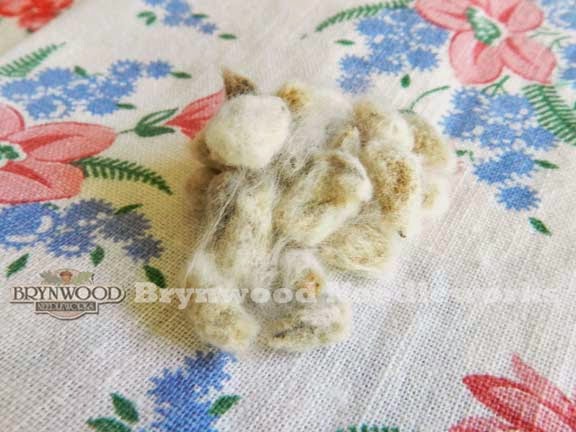
Cecelia also gave me some cotton seeds so I could try growing my own plants!
Feedsacks became more colorful, with printed patterns that could more readily be used for dresses, tablecloths, curtains, pre-printed fabrics that were sewn together to make stuffed toys, and of course, those functional (and now beloved) quilts.

After World War II, heavier paper and plastic were more economical containers. The manufacturers then incorporated polyester into their bags, and the sacks soon fell out of favor with farm wives, who preferred the 100% cotton for their purposes. The cotton feedsacks were only produced until 1965, and the vintage ones have have become cherished collectibles.
A free handout from Cecelia of Pat's Sacks
I am, by no means any expert in this field. Most of what I'm sharing is due to the knowledge Cecelia shared with our guild on Tuesday evening. There are, however, many sources available to learn more about this fascination subject. 

In case you're interested, I know that there are a many examples of feedsack fabric and actual intact feedsacks available on Ebay (Don't bid against me, please). Have fun learning more thanks to the internet.

Thanks for the question, Mandy! I hope this helps clear things up a bit.
DonnaAcornSignature

June 3, 2012

Inspiration Overload - and Friendship...

"Graceful Baltimore" by A Graceful Stitch
On Friday, I went shopping with my friend, Kathy D. in Wisconsin. She picked me up and together we traveled to Menasha and Appleton to check out three quilt shops I'd never visited before.

I tried to take photographs of the interiors of the shops, but my images just didn't do them justice, so I'm going to share a few pictures of some of my favorites of their shop samples. I'll tell you that each shop was just exploding with inspiration!
"Noah's Arc" in Wool Applique'
The first shop Kathy took me to was one of her personal favorites, and I can certainly see why. It's called Primitive Gatherings and it's on Racine Street in Menasha. (Here's a link to their website to whet your appetite!)

It's a one story converted home with additional inspiration in the basement. I took more than a few laps around the shop (up and down) before I could even begin to decide what I had to purchase from them! I told Kathy that if she had trouble finding me, I'd probably be sitting in a corner crying in confusion over all the fabulous things they had to offer. I'll show you my purchases later in the week. I can tell you, I had a ball in their shop.

The Noah's Arc hanging (above) is just one of the gorgeous wool pieces they had on display. In the end, I did join one of the monthly block of the month groups, too. It's the Jacqueline's Album Quilt BOM (here). I know. Like I need another project, but this one was just too cool to pass up!

Nick and Lisa Bongean (the owners) have created a gorgeous shop, and Lisa designs many of the pieces that adorn the walls. I'll visit their again in the future (online and in person!).
"Spoolin' Around" by Gingham Girls
Next, we went to Going To Pieces Quilt Company on Northland Avenue in Appleton, WI. Owned by Mary Klein and Joanne Mjos, this shop had a completely different feel and lines and designs different from the primitives, wools and reproduction fabrics at the first shop.

Remember, I told you I was going to start making nine-patch blocks from my project scraps? Well, I know how I'm going to assemble them after seeing this pattern called "Spoolin' Around"! Isn't it great? Alas, they have no website that I can steer you to.
"Provence Flannel" by Marcus Brothers @ Going To Pieces Quilt Shop
I went back to the table more than once, but resisted the temptation to pick up this flannel fabric kit called "Provence Flannel". The pattern is free from Marcus Brothers and I love the fabrics that were used to create this quilt. It's soft, colorful and it really spoke to me. (Even though I kept trying to put my hands over my ears!) I may yet call the shop and have them ship the kit to Florida.
Quilted Clock @ Going To Pieces Quilt Company
How's this for a perfect way to tell the time in your studio? I saw it on the wall at Going To Pieces and just had to share it with you! The numbers are machine embroidered and the rest is pieced, quilted and bound. It has enough substance to stay rigid as a clock. So cool!
"Hot Cross Buns" by Schnibbles @ Primitive Gatherings
The third shop was Keep Me In Stitches on Richmond Street in Appleton. It's just around the corner from Going To Pieces, but their shop had yet another completely different atmosphere! They don't have a website either, so I can't steer you to a site so you can see more.

Kathy and I had a ball shopping, ate a great lunch near the river in Menasha, and thoroughly enjoyed catching up with each other. (Congratulations to her newly-graduated son who just got a new job in the computer field in Appleton!)

We're already looking forward to the next time I visit Wisconsin so we can get together for another day of shopping! Thanks for driving, Kathy...and for your ongoing friendship. You're a true inspiration, my friend.
DonnaAcornSignature